-
Welcome to your new Gnomio site
Now, you are in control!
Moodle is an open-source Learning Management System (LMS) that provides educators with the tools and features to create and manage online courses. It allows educators to organize course materials, create quizzes and assignments, host discussion forums, and track student progress. Moodle is highly flexible and can be customized to meet the specific needs of different institutions and learning environments.
Moodle supports both synchronous and asynchronous learning environments, enabling educators to host live webinars, video conferences, and chat sessions, as well as providing a variety of tools that support self-paced learning, including videos, interactive quizzes, and discussion forums. The platform also integrates with other tools and systems, such as Google Apps and plagiarism detection software, to provide a seamless learning experience.
Moodle is widely used in educational institutions, including universities, K-12 schools, and corporate training programs. It is well-suited to online and blended learning environments and distance education programs. Additionally, Moodle's accessibility features make it a popular choice for learners with disabilities, ensuring that courses are inclusive and accessible to all learners.
The Moodle community is an active group of users, developers, and educators who contribute to the platform's development and improvement. The community provides support, resources, and documentation for users, as well as a forum for sharing ideas and best practices. Moodle releases regular updates and improvements, ensuring that the platform remains up-to-date with the latest technologies and best practices.
Links of interest:
(You can edit or remove this text)
Available courses
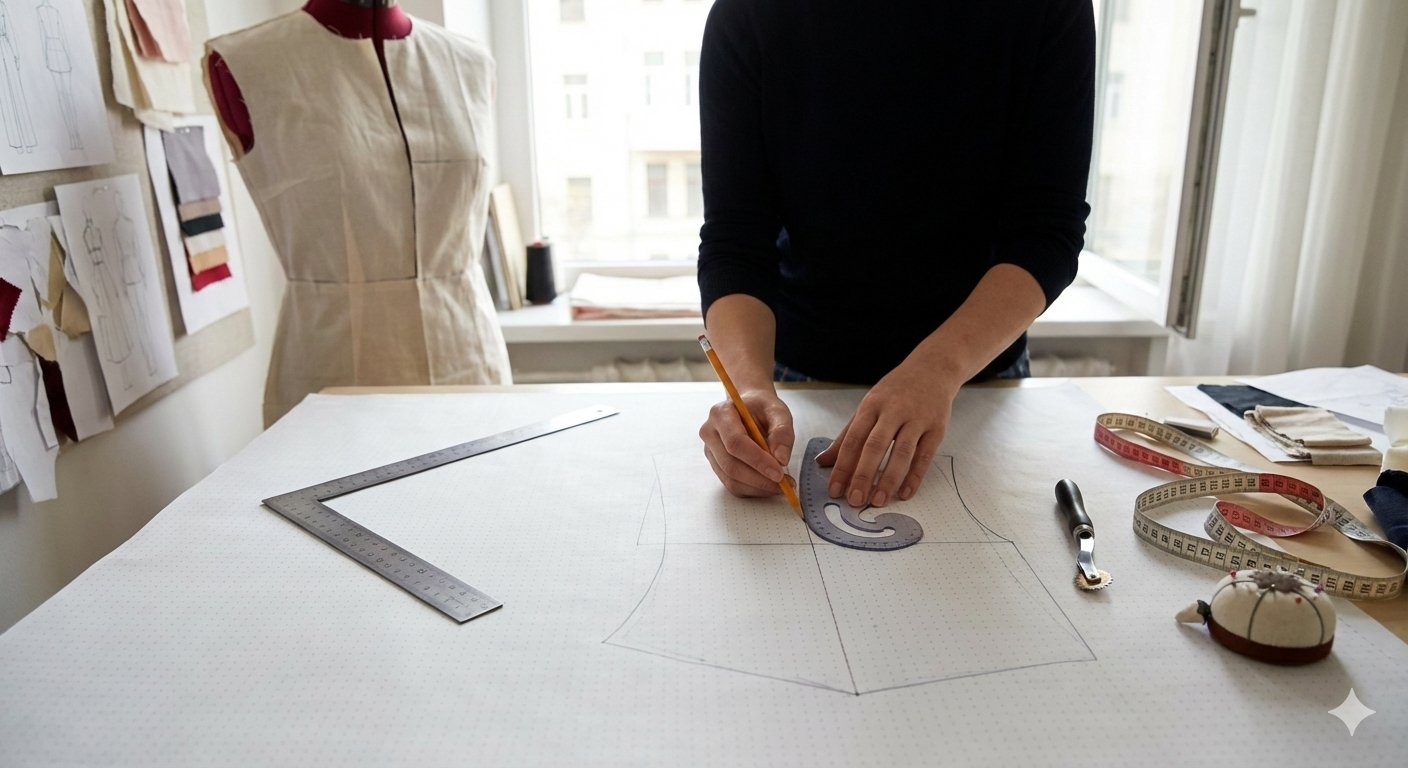
A Pattern Drafting course is the technical heart of fashion design. It is the bridge between a two-dimensional sketch and a three-dimensional garment. This course teaches you the "engineering" of fashion—how to create the flat paper templates (patterns) used to cut fabric so that it fits the human body perfectly.
## Course Overview
Pattern drafting focuses on precision, geometry, and anatomy. You start with a "sloper" or "block"—a basic foundation pattern—and learn to manipulate it into infinite styles, from a simple T-shirt to a complex evening gown.
### Key Learning Areas
-
Flat Pattern Manipulation: Using "slash and spread" techniques to move darts, create gathers, or add volume (like puff sleeves or flared skirts).
-
Measurements & Sizing: Learning how to take professional body measurements and apply them to paper with $1/16$-inch accuracy.
-
Drafting the Essentials: Mastering the four "core blocks":
-
The Bodice: Managing bust and waist shaping.
-
The Sleeve: Calculating the "cap height" for arm movement.
-
The Skirt: Drafting various silhouettes (A-line, pencil, gathered).
-
The Trouser: Understanding the complex "crotch curve" for comfort and fit.
-
-
Technical Details: Adding "seam allowances," notches for assembly, and "grainlines" to ensure the fabric hangs correctly.
### Summary Table: The Drafting Process
| Stage | Activity | Goal |
| Foundation | Drafting the Basic Block | Creating a "second skin" template. |
| Manipulation | Pivot & Slash Techniques | Transforming the block into a specific design. |
| Test Fit | Sewing a "Toile" (Muslin) | Checking the paper math on a real body/form. |
| Finalization | Grading & Tech Packs | Adjusting the pattern for different sizes (S, M, L). |
### Why It Matters
Without pattern drafting, a design is just a drawing. This skill allows a designer to control fit, proportion, and silhouette. In the modern industry, this is often done using digital software, but learning the manual "pencil-and-paper" method is essential for understanding how fabric behaves over the curves of the body.
Fun Fact: Pattern drafting involves a surprising amount of math! You'll use geometry to calculate curves and $360^\circ$ rotations to ensure pieces align perfectly.
- Teacher: mouline wagaya
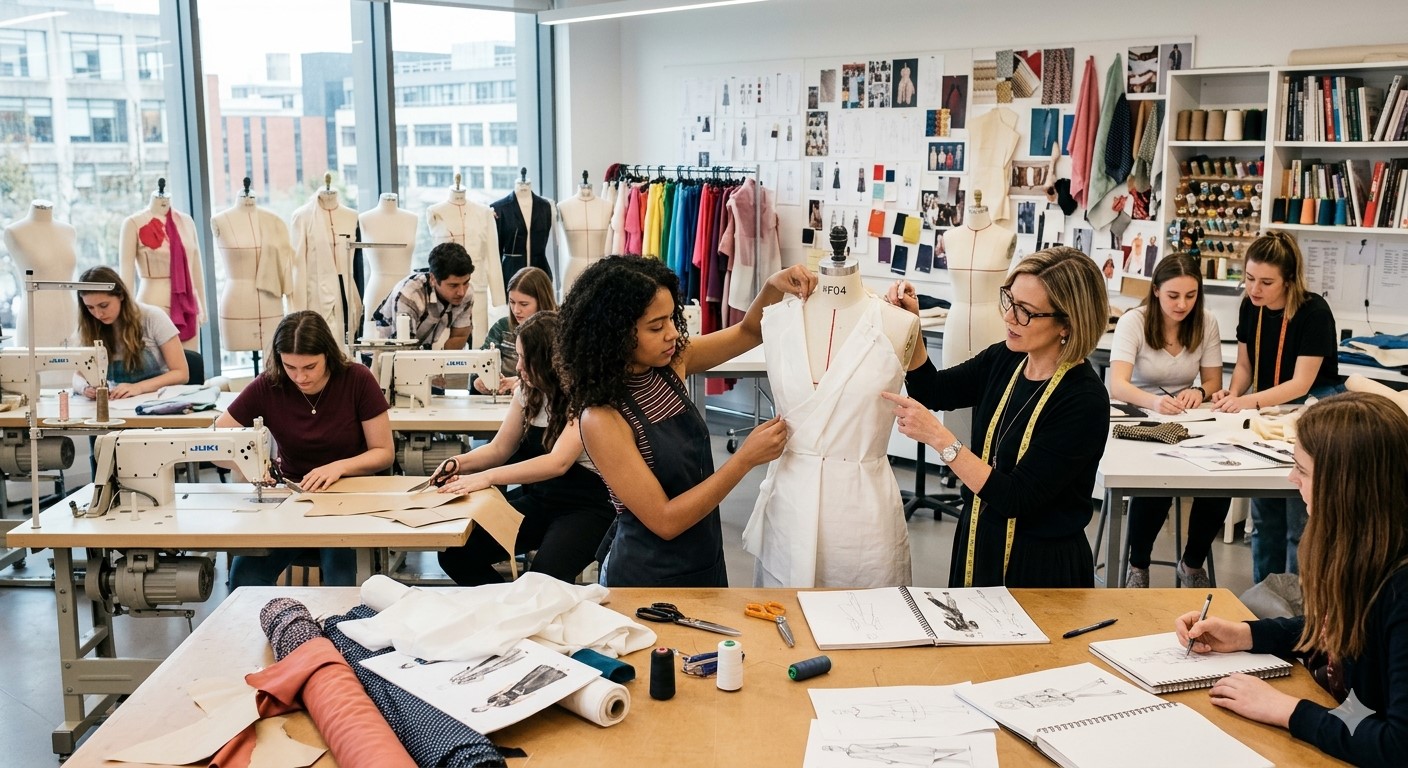
A Fashion Design course summary provides a high-level overview of the journey from a raw concept to a finished garment. It’s a mix of artistic expression, technical engineering, and business strategy.
Here is a concise summary of what the experience looks like:
💡 The Creative Core
The course starts with visual storytelling. You learn to observe the world through a designer's lens, using research to build "mood boards" that define the aesthetic of a collection. This phase focuses on:
-
Fashion Illustration: Mastering the $9$-head proportion figure (croquis).
-
Color & Textile Theory: Understanding how fabrics move, breathe, and take dye.
🛠️ The Technical Foundation
This is the "blue-collar" side of fashion. You move from 2D sketches to 3D reality.
-
Pattern Drafting: Creating the flat paper templates used to cut fabric.
-
Draping: Shaping fabric directly on a mannequin to see how it hangs ($360^\circ$ design).
-
Construction: Mastering industrial sewing, tailoring, and couture finishing techniques.
📈 The Professional Edge
Modern fashion isn't just about making clothes; it’s about selling a vision.
-
CAD (Computer-Aided Design): Using software like Adobe Illustrator or CLO 3D to create digital technical packs.
-
Sustainability: Learning to design for longevity and ethical production.
-
Portfolio: Developing a curated book of work to land a job at a design house or launch a private label.
The Program Arc
| Stage | Milestone |
| Year 1 | Mastery of the sewing machine and basic sketching. |
| Year 2 | Experimental textiles and complex garment tailoring. |
| Year 3 | Brand identity and the creation of a signature "Senior Collection." |
Bottom Line: A fashion design course doesn't just teach you how to make clothes—it teaches you how to solve problems visually and technically within the global marketplace.
- Teacher: mouline wagaya